The Five-Stage Pipeline
TracePcap is a modular wrapper around a growing suite of functions. The architecture exists so that new capability is added by dropping a module into a stage, not by editing a core. Every boundary below was admitted under one test:
A stage boundary earns its existence only if modules can be added on one side without touching the other side.
Stages follow the order data changes shape — packets → facts → insights → conclusions → narrative:
Ingest → Extract → Scan → Adjudicate → Narrate        Present = the read surface over all
           │          │        │
           │          │        └─ exclusive: one adjudicator per question;
           │          │           human annotations enter here, ranked first;
           │          │           "contested" is a legal, displayable outcome
           │          └─ additive: scanners derive insights from facts;
           │             contradiction between facts is itself a finding
           └─ observations with witnesses: append-only, conflict-preserving,
              graded MEASURED / REPORTED / INFERRED, plus a run manifest
Determinism is not a stage. Every stage contains deterministic (D), LLM-driven (L), and human-annotated (H) capabilities; the tier is tagged per capability. Prefer D — an LLM must earn its place by doing something determinism cannot, not by being easier to write.
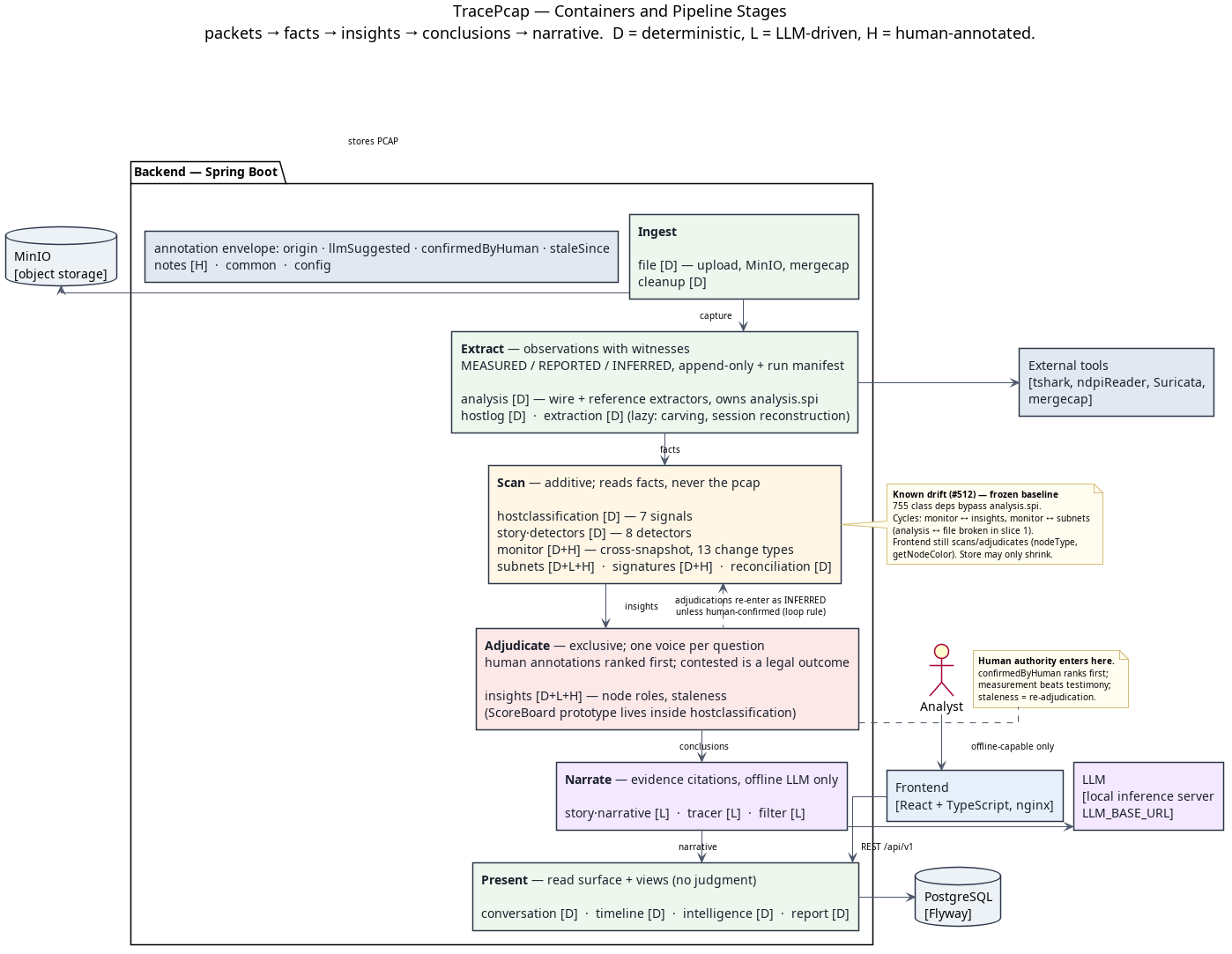
Containers and backend stages. Regenerate with
plantuml docs/architecture/c4-container.puml.
Stage contracts
Ingest
Capture in, bytes stored, analysis scheduled. Byte-level plumbing (merge, checksum, retention)
belongs here — including external tools that manipulate captures without reading into them
(mergecap in FileServiceImpl).
Add a module when: a new way for captures to arrive or be prepared (windowed ingest, dedup, capture-quality assessment — truncation, clock skew, one-sidedness — feeding the manifest).
Extract
Digs every available fact out of the capture. Deterministic, and its records are definitive: each fact is an observation with a witness — what was observed, where (frame/protocol), when, by which extractor at which version.
Three grades, fixed per fact type at schema level:
Grade |
What it is |
Examples |
|---|---|---|
MEASURED |
A property of the traffic itself. Nothing “said” it; it was exhibited. |
byte counts, timestamps, ports, observed TTL, who sent SYN |
REPORTED |
Content asserted by a network party. The assertion event is measured; the assertion content is testimony from an untrusted party. |
DHCP hostname, NBNS name, HTTP User-Agent, TLS cert subject |
INFERRED |
A third-party tool’s judgment — deterministic to run, but heuristic, with known error modes. |
nDPI app identification, Suricata alerts, GeoIP/OUI lookups |
Rules:
Append-only; no winner-picking at write time. Two conflicting hostname claims are both stored. Conflicts are resolved downstream (Adjudicate) and detected as findings (Scan) — a claim erased at write time can never be scanned.
IpMacObservationEntityis the pattern done right;HostnameResolverService(picks a winner by source priority, discards the rest) is the pattern done wrong — see Known divergence.Run manifest. Every extractor reports its own status per file — ran / failed / partial, facts produced, extractor version. Downstream must consult it: “nDPI didn’t run” and “nDPI ran and couldn’t identify” are different states (the #501 bug is exactly this conflation). Versioned provenance also enables backfill: when an extractor is added or fixed, the manifest says exactly which files to re-run.
Two sub-kinds. Wire extractors read the capture (
PcapParserService,NdpiService,HostnameResolverService, hostlog extractors). Reference extractors join extracted facts against bundled reference data (GeoIP, OUI) — they need no pcap access and can backfill after the capture has been aged out.Extraction may be lazy. Session reconstruction and file carving read the pcap on demand; they are Extract-stage work triggered late, not exceptions to the rule.
The capture caveat. Even MEASURED facts are definitive about the capture, not the network — drops, truncation, and one-sided flows mean absence of a fact is never evidence of absence.
Add a module when: there is a protocol or edge case to mine — deliberately the widest surface. One protocol quirk = one extractor = zero downstream changes. (LLMNR #511, 802.1Q #464, DHCPv6, Kerberos, SMB, SNMP sysDescr, per-flow entropy #501/#505, JA4 …)
Scan
Reads the fact base — never the pcap — and derives insights: judgments with confidence and reasons. Scanners are additive: a new scanner never conflicts with an existing one; it just adds insights.
Rules:
Judgment is the boundary. Deterministic recombination with nothing to contest (timeline bins, protocol breakdowns, top-hosts tables) is a view, not an insight — views live with Present and are never adjudicated.
Contradiction scanners are a first-class family. In this product, fact conflicts are findings, not QC noise: ARP spoofing is an IP/MAC conflict; impersonation is a hostname-vs-certificate conflict. Severity follows the grades — two REPORTED facts disagreeing is mild; REPORTED contradicting MEASURED is where attacks live.
Scope is an attribute, not a stage: per-capture (beacons, fan-out) or cross-snapshot (pattern-of-life, drift, convention learning #507).
The loop rule. Cross-snapshot scanners may consume adjudications (device identity survives IP churn only as an adjudicated question), making the pipeline iterative, not a strict DAG. A scanner consuming an adjudication treats it as INFERRED unless human-confirmed — machine conclusions inform but never self-reinforce at full weight (the #507 circularity guard, made structural).
Add a module when: facts can be combined into a judgment (centrality #503, volumetric z-scores #505, unknown-traffic characterisation #501, port-scan/exfil detectors, slow beacons #504).
Adjudicate
Answers questions with one voice. Where scanners are additive, adjudicators are exclusive: one adjudicator per question (“what is this host?”, “what is its name?”, “which subnet?”), and adding a second for the same question is a conflict, not an addition.
Contract: consume competing insights and human annotations as ranked inputs — human confirmed
first; weigh by fact grade (measurement beats testimony); produce a winner with confidence
or an explicitly contested outcome — contested is legal, displayable, and narratable.
Conclusions are versioned and revisable: when underlying facts change, re-adjudication fires —
staleSince is not a bolt-on, it is this mechanism.
ScoreBoard (weighted votes → winner + margin confidence) is the working micro-prototype,
currently living only inside device classification. #499’s conflicting-identity bug is the
absence of a host-identity adjudicator; #498 (“surface uncertainty”) is simply exposing the
adjudication margin.
Add a module when: a new question domain needs one voice (host identity #499, hostname #511, device type with user evidence #506, subnet membership #502).
Narrate
Turns insights into prose a human can act on. LLM-driven, always offline-capable
(LLM_API_BASE_URL → local inference server; no hosted APIs).
Contract: narrators emit evidence references with every claim; a deterministic citation
checker verifies the references resolve to real facts. InvestigationService’s
hypothesis → query → evidence loop is halfway to this already.
Add a module when: a new narrative product is needed (cross-snapshot stories #504, comparative “what changed” narratives, report templates).
Present
The thin read surface: REST API, views (the no-judgment aggregations from the Scan rule), rendering, export. Present consumes adjudications; it never makes them — see Known divergence for where the frontend currently violates this.
Add a module when: a new way to see or export what the pipeline already knows (timeline-union diagrams #510, heatmaps #505, tiered layout #509, evidence export).
The annotation envelope
Annotation is not a stage — it is the envelope on everything. A human can annotate at every altitude: correct an extracted hostname, override a classification, confirm a subnet label, dismiss a narrative finding. Every fact and every conclusion carries:
private String origin = "MANUAL";      // MANUAL | AI | CARRIED_FORWARD
private boolean llmSuggested;
private boolean confirmedByHuman;
private LocalDateTime staleSince;      // + staleFields
NodeRoleEntity is the reference implementation: the machine proposes, the human disposes,
provenance is retained, and the label goes stale when the evidence beneath it moves. Human
annotations get their authority at Adjudicate (ranked first), and confirmedByHuman data is
the only kind that feeds back into scanning at full weight.
New annotation surfaces must reuse this shape. Where they have not, the cost is visible: device
classification has no override path at all while signatures.yml carries a separate,
incompatible one (#506).
A worked example
10.0.0.66 DHCP-declares itself “DC-01”. The real domain controller is 10.0.0.10.
Stage |
What happens |
|---|---|
Ingest |
The capture lands, is checksummed and queued. |
Extract |
The DHCP extractor records the announcement (REPORTED, frame 812). The TLS extractor records 10.0.0.10’s certificate CN=DC-01 (REPORTED, cryptographically backed). Traffic extractors record both hosts’ behaviour (MEASURED). All three observations stored, append-only — no winner picked. The manifest shows every extractor ran clean. |
Scan |
The identity-conflict scanner sees two hosts claiming one name, one claim contradicting a certificate → insight “possible impersonation, HIGH”, citing both frames. The traffic scanner notes 10.0.0.66’s MEASURED behaviour (fresh MAC, client-like pattern) does not match a domain controller. |
Adjudicate |
The hostname adjudicator, weighing certificate above DHCP testimony, gives 10.0.0.10 the
name |
Narrate |
“10.0.0.66 announced the domain controller’s name 12 minutes after joining the network; certificate evidence contradicts the claim” — each clause citing frames, references verified by the citation checker. |
Present |
The graph renders 10.0.0.66’s label as contested (⚠), not as a confident lie. NodeDetails lists all three claims with sources. |
Under the current code this attack is invisible: HostnameResolverService picks one name
at write time and discards the rest, so the conflict never exists for anything downstream to
find.
The slow-burn beacon (#504) runs the same rails at cross-snapshot scope: one connection per capture is nothing; facts and manifest persist; a cross-snapshot scanner — consuming adjudicated device identity per the loop rule — sees the same pair at the same hour across nine snapshots and emits a periodicity insight no single capture could contain.
Modules by stage
Twenty backend modules under com.tracepcap, placed by centre of gravity. Tier key:
D deterministic · L LLM-driven · H human-annotated.
Stage |
Module |
Tier |
Notes |
|---|---|---|---|
Ingest |
|
D |
Upload, MinIO storage, merge ( |
Ingest |
|
D |
Retention and disposal. |
Extract |
|
D |
The 7-stage orchestrator + wire extractors ( |
Extract |
|
D |
Per-host service-log extractors (DNS, HTTP). |
Extract |
|
D |
Lazy extraction: file carving. Its read API is Present. |
Scan |
|
D |
7 |
Scan |
|
D |
8 per-capture scanners: beacon, volume, fan-out, TLS anomaly, unknown app, … |
Scan |
|
D + H |
Cross-snapshot scanner ( |
Scan |
|
D + L + H |
Density detection (D); LLM label suggestion (L); manual confirm (H). |
Scan |
|
D + H |
User-authored rules ( |
Scan |
|
D |
Cross-source identity reconciliation. |
Adjudicate |
|
D + L + H |
Node roles + |
Narrate |
|
L |
|
Narrate |
|
L |
LLM-assisted conversation tracing. |
Narrate |
|
L |
NL → display filter. Validates generated filters against the pcap — a grey case, see Known divergence. |
Present |
|
D |
Conversation read API; raw-frame export (evidence export, not fact derivation). |
Present |
|
D |
Views (time-binned aggregation — no judgment). |
Present |
|
D |
Views (clusters, top hosts, service summaries). |
Present |
|
D |
PDF/report generation. |
envelope |
|
H |
Free-text annotation. |
— |
|
— |
Cross-cutting; depended on by everything, depend on nothing. |
Dependency rules
Feature → analysis, never the reverse (#416). The pipeline owns ports (
analysis.spi); feature modules implement them.Cross the boundary through the seam —
analysis.spi/analysis.dto, neveranalysisrepositories or entities.No cycles between modules.
Raw-capture access is confined to Ingest byte-plumbing, Extract (eager or lazy), and evidence export. Everything else reads the database. If a scanner needs new raw data, that is a missing extractor — not a licence to shell out.
commonandconfigare depended on by everything and depend on nothing.
All four are enforced (frozen) by ArchUnit — see Architecture Enforcement.
Known divergence
Measured against the model above; frozen in the ArchUnit baseline where enforceable. Each entry is a refactor target, not a shrug.
66 class dependencies bypass
analysis.spiand reach intoanalysisrepositories or entities (rule 2) — down from 757 (757 → 738 in slice 6a, → 687 in 6b, → 529 in 6c, → 66 in 6d). Approaching the documented residual: 27 areDeviceClassifierService(accepted, see below), 10 areextraction’s cross-module FK, 26 areInvestigationService. Rule 1 holds at zero violations. Module cycles: zero — three were eliminated across slices 1 and 3:analysis ↔ file(listener moved to its consumer),monitor ↔ insightsandmonitor ↔ subnets(amonitor.spiport package —LabelStalenessCheck,SnapshotRevalidationHook,InsightPresence— implemented byinsights/subnets, plusNodeRoleChangedEventrelocated tocommon.eventas shared vocabulary, since publisher and consumer sit on opposite sides of the Scan/Adjudicate loop). Lesson kept for posterity: ArchUnit’s cycle enumeration understates until the last cycle is gone —monitor ↔ subnetsonly surfaced afteranalysis ↔ filewas fixed.Hostname claims are now conflict-preserving (slice 4):
HostnameResolverServicerecords every claim intohostname_claims(V33), andHostnameAdjudicatorpicks the display winner with the old semantics — same winners, but losing claims survive, so #511’s identity-conflict scanners finally have evidence to read. The adjudicator is hosted inanalysisuntil a dedicated Adjudicate module exists (analysismust not depend on feature modules — frozen rule). Contested IPs are counted and logged; surfacing them as findings and UI state is #511’s work.``WebServerLogExtractor`` mixes stages — extraction (endpoint logging) and scanning (the api/web role decision that #496 flags as broken) in one pass.
Run manifest exists for nDPI only (slice 2):
extraction_runsrecords COMPLETED/FAILED/SKIPPED per file, served through theExtractionManifestSPI port, andUnknownAppDetectornow reports a skipped/failed run as aCOVERAGE_GAPfinding instead of “100% of Traffic Has Unknown Application, HIGH” (#501). Remaining extractors (tshark enrichment, Suricata when it runs, hostname resolution, service logs) are not yet instrumented — their absent rows mean “unknown provenance”, same as pre-manifest files.Present no longer scans or adjudicates (#521, resolved).
networkService.tsused to computenodeTypefrom ports/nDPI (scanning) andgetNodeColorresolved the nodeType-vs-deviceType conflict by display precedence (adjudicating) — client-side, on a truncated 50-node set, so a host could classify differently depending on what else fit on screen. All four functions (determineRole,finalizeNodeRole,classifyNodeType,getNodeColor’s precedence) are deleted.rolereadsinitiatorIp(the MEASURED SYN fact, #496);nodeTypeis a projection of the adjudicated host identity through one label map, so the two taxonomies that both contained “Web Server” (#499) become one — the adjudicator decides, the graph renders. Legacy files with classifications but no identities backfill lazily on first read ofGET /files/{fileId}/host-identities(idempotent).The first real adjudicator exists (slice 5):
HostIdentityServiceininsightsanswers “what is this host?” with one voice — human-confirmed node-role labels ranked first, then the classification vote (whose runner-up is now persisted so a knife-edge is distinguishable from a walkover), with an explicit contested outcome listing candidates. Re-adjudication fires onAnalysisCompletedEventandNodeRoleChangedEvent(staleness IS re-adjudication, live). Served atGET /files/{fileId}/host-identities, and — as of #521 — this is what the graph renders: the frontend consumes the adjudication instead of computing its own (closing #499).``insights`` is fully behind the seam (slice 6b): 34 → zero.
NodeRoleServiceandLabelStalenessServiceread hosts throughHostClassificationLookupand external orgs through the newGeoOrgLookup;HostClassificationsControllerreads through the port and the newIpMacObservationLookup. Three ports rather than one on purpose — the shapes are genuinely different questions (a host’s description, an IP’s claimants, a peer set’s orgs), and widening one port to serve all three is how a seam decays back into a repository. Note the split withinHostClassificationLookup:ClassifiedHostcarries the contest (winner + runner-up) for adjudication,HostFactscarries the description for display and prompt context. Logic the consumers used to duplicate — splitting the comma-joinedservice_rolescolumn, grouping observations by IP, filtering blank orgs — now lives in the adapters, which is what makes the port’s javadoc a promise rather than a suggestion.``hostclassification``’s 27 remaining violations are accepted, not pending. They are all
DeviceClassifierService.classify, which implements theHostClassifierport — a port whose own signature returnsHostClassificationEntity. The class touches the entity because the seam hands it over; that is the contract working. The rule matches package names and cannot distinguish “reached around the port” from “used the type the port gave you”. Clearing them means changing whatHostClassifierreturns — the entity conceptually belongs tohostclassificationbut physically lives inanalysis.entityfor JPA’s sake — which is a schema-shaped change, not seam work. Do not “fix” these by rewriting the classifier.The conversation fact base is behind the seam (slice 6c): 687 → 529.
tracer56 → 0,monitor66 → 3,extraction49 → 10. Consumers read ~24 distinct fields offConversationEntity, soConversationFactscarries three nested groups rather than 24 flat fields — and the grouping is the fact grades, which fell out of measuring what each module reads rather than being imposed:FlowIdentity(MEASURED — endpoints, bytes, times; read by everyone),TlsFacts(REPORTED — cert subject, JA3, SNI; the fields a host can forge), andFindings(INFERRED — nDPI app, Suricata alerts, risks). One record and one query, though: three ports would mean three round-trips over the same row.PacketLookupis separate, because the grain differs — folding packets into a conversation would drag thousands of rows behind every timeline bin.Two structural reaches that field-level porting cannot close, both now handled:
ConversationRepository.buildSpecreturnsSpecification<ConversationEntity>— the entity sits in the caller’s signature, sointelligence/conversation/storywere coupled to it by type, not by field access. The port takesConversationFilterParams(already on the seam) and keeps the 168-line Specification insideanalysis: callers say what they want, not how rows are selected.ExtractedFileEntityholds a JPA@ManyToOnetoConversationEntity. The FK crosses the module boundary at the schema level, so no read port removes it — same class asDeviceClassifierService, structural rather than lazy.extraction’s residual is this.
All four stages are registries — Extract, Scan, Adjudicate and Narrate each discover their own modules, so adding capability is adding one class. Each has a probe module in its tests: one class, registered nowhere, touching nothing in
main, asserted on by its output rather than by bean counts. Verified live on real captures:Extract 3 extractors (3 DETERMINISTIC) Scan 8 scanners (8 DETERMINISTIC) Adjudicate 1 adjudicator (1 DETERMINISTIC) — questions: host-identity Narrate 1 narrator (1 DETERMINISTIC)
The contracts differ per stage, because the stages differ:
Extract writes.
ExtractionTargetcarries the mutable working set; extractors fill in conversations before persistence. The module owns its own enable conditions (Suricata’s global kill-switch moved out ofAnalysisServiceontoSuricataService), and the manifest row is automatic — an extractor cannot forget, and forgetting is the #501 conflation.tsharkgained a manifest row it never had, for free.Scan reads.
ScanContextcarries immutable facts, memoised so eight scanners asking for the conversation list read the database once. Additive: a new scanner never conflicts.Adjudicate is exclusive. One voice per question — so discovery alone would be the wrong contract.
AdjudicatorRunnerrefuses to start when two modules claim one question, because picking by bean order would make the answer change with an unrelated refactor. TheAFTER_COMMIT/REQUIRES_NEWplumbing that every adjudicator used to copy is written once.Narrate reads conclusions. A narrator that judges is a scanner nobody can inspect. Its output reaches the UI:
CoverageNarratoris DETERMINISTIC and states what the capture could not tell us — the section a language model should never write — in front of the LLM’s prose. Before the registry every section came from one LLM call, because there was only one way in.
Tierlives incommon.stage: every stage holds all three tiers, and an extractor and a scanner answer to the same three words. The D/L/H taxonomy is something the code knows, not a table in this document.Scan was the first stage to get its registry (slice 6d) — the first slice that built the playbook rather than clearing the way for it.
FindingsServiceheld eight detector fields and eight call lines; a ninth detector meant editing it, which is the “edit a core to add capability” this whole architecture exists to prevent. It now injectsList<Scanner>and names nobody.The blocker was signature drift: the eight detectors had five different
detect(..)signatures between them, so there was no common interface to list-inject — which is why no registry existed.ScanContextcollapses them into one, memoising its reads so eight scanners asking for the conversation list read the database once.story.spinow holds the three types the playbook is built on:Scanner—name(),tier(),scan(ScanContext). Every implementation is discovered.Tier—DETERMINISTIC/LLM/HUMAN_ASSISTED, declared by the module itself. The D/L/H taxonomy stops being a table in this document and becomes something the code knows.ScanContext— the facts a scanner may read. Growing it as a new scanner needs a new fact is the seam working; a scanner taking a bespoke parameter is not.
Discovery is Spring
List<T>injection, the patternSnapshotRevalidationHookalready uses (slice 3) — zero new machinery, and reversible:Scanneris the contract, and how instances are found can change without touching a scanner.The definition of done, and how it is enforced:
ScannerRegistryTestdeclares a probe scanner in a test file, registered nowhere, touching nothing inmain— then asserts on the finding that comes back throughFindingsService. Its first version checked bean counts instead, and passed against aFindingsServicewhose scanner list had been emptied; that is precisely the failure it exists to catch, so it observes output now.``FilterService`` reads the pcap to validate LLM-generated filters — the one grey case in rule 4, baselined rather than blessed.